If you have researched natural-looking facial rejuvenation, you have probably met the term collagen biostimulator — and then immediately run into a list of product names that all sound similar. Sculptra, Loviselle, PCL: what actually separates them, and does the choice matter? This guide explains what these treatments have in common, where they genuinely differ, and how a suitable one is chosen for a particular face.
First: What Is a Collagen Biostimulator?
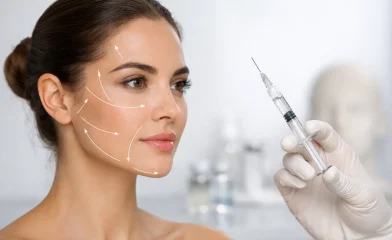
A biostimulator is not a conventional filler. A hyaluronic acid filler adds gel volume immediately where it is placed, and that gel is what you see. A biostimulator instead prompts your own skin to produce collagen over the following weeks and months — the material acts as a signal, and the improvement you eventually see is your own tissue.
That difference explains the two defining characteristics of every biostimulator: results appear gradually, and they address overall structure and skin density rather than filling one precise point. If this distinction is new to you, our comparison of Sculptra vs. traditional fillers is the clearest starting point, and our complete guide to PLLA covers that material in depth.

The Two Main Materials
PLLA (Poly-L-Lactic Acid)
PLLA is one of the longest-established biostimulator materials. It works by creating a gentle, controlled stimulus that encourages fibroblasts to lay down new collagen across a broad area, which makes it well suited to generalised volume loss and thinning rather than a single hollow.
Both Sculptra and Loviselle are PLLA-based biostimulators. They share the same underlying principle, and differ in their formulation and preparation rather than in the fundamental way they work. A note on naming, because it causes confusion: our PLLA Collagen Biostimulator service uses Sculptra, while Loviselle is a separate PLLA product. If you are unsure which a clinic is quoting for, ask by product name.
PCL (Polycaprolactone)
PCL-based biostimulators also stimulate collagen, but the carrier provides a degree of immediate support alongside the gradual collagen response. In practice this can suit patients who want some early structure while the collagen builds, particularly where contour and definition are the goal.
So Which One Is Right for You?
This is the honest answer patients rarely get online: the correct choice depends on your anatomy, how much volume has been lost, how gradually you want to see change, and your timeline — not on which product is currently most talked about.
Broadly speaking, the questions that matter are:
- Is the concern generalised thinning and loss of density, or a specific contour?
- Do you prefer change so gradual that nobody can point to a date, or do you want some earlier structure?
- How many sessions and what timeline suit your schedule?
- What has your face responded to before?
Our PLLA treatment planning guide explains how dosage and session count are decided, and how long PLLA results last sets out a realistic timeline.

What All Biostimulators Ask of You
Whichever material is chosen, two things are consistent. First, patience: you are growing collagen, and that takes weeks to months. Second, technique and aftercare matter — correct preparation, appropriate placement and following your clinic’s post-treatment instructions are what keep results smooth and even. This is not a category where the cheapest quote is the best value; we explain why in how much Sculptra costs in Singapore.
Where Biostimulators Fit in a Wider Plan
Biostimulators rebuild density and support. Where skin laxity is the dominant concern they are not a substitute for a dedicated tightening treatment, and they do not relax expression lines. Where laxity is also a concern, they are often planned alongside a tightening treatment such as Ultraformer MPT, which we explain in our guide to non-surgical face lifting. Starting earlier, while you still have density to preserve, is the thinking behind collagen banking in your 30s. Where the concern is a specific crease rather than general density, see our guide to smile lines and nasolabial folds.
The Bottom Line
Sculptra, Loviselle and PCL biostimulators all work by encouraging your own collagen — the meaningful differences lie in material, formulation and how gradually each delivers. The right one is chosen by assessment, not by brand recognition.
Not sure which suits your face? Book a consultation and we will assess your structure, explain the options clearly, and recommend only what your goals actually call for.