Introduction
In a world accustomed to instant gratification, PLLA (Poly-L-Lactic Acid) asks for something rare: patience. Unlike hyaluronic acid fillers that deliver immediate satisfaction, PLLA is a biostimulator that operates on your body’s biological clock. This often leads to confusion. Patients leave the clinic looking great, wake up two weeks later looking exactly as they did before, and wonder if the treatment failed. It hasn’t. It has only just begun.
Understanding this timeline is critical for satisfaction. While our main guide on PLLA Singapore: The Comprehensive Guide to Collagen Biostimulators covers the broad benefits, this article is dedicated entirely to the when. We will map out exactly what happens under your skin from the moment of injection to the two-year mark.
PLLA results typically last up to 25 months, significantly longer than standard hyaluronic acid fillers. However, the results are not immediate. After an initial temporary volume boost from the carrier fluid dissipates (within days), true collagen production begins around week 4 to 6, peaking at month 6. A maintenance session is usually recommended once every 12 to 18 months to prolong these effects.
Table of Contents
- The Biology of Duration: Why It Outlasts Fillers
- Phase 1: The “Cinderella Effect” (Days 1–5)
- Phase 2: The “Volume Gap” (Weeks 2–6)
- Phase 3: The Ascent (Months 3–6)
- Phase 4: Long-Term Maintenance (Years 1–2)
- Variables That Influence Your Timeline
- Frequently Asked Questions
- Conclusion
The Biology of Duration: Why It Outlasts Fillers
To understand the longevity of PLLA, you must understand the mechanism. You are not buying a prosthetic volume; you are investing in tissue regeneration.
Active Stimulation vs. Passive Filling
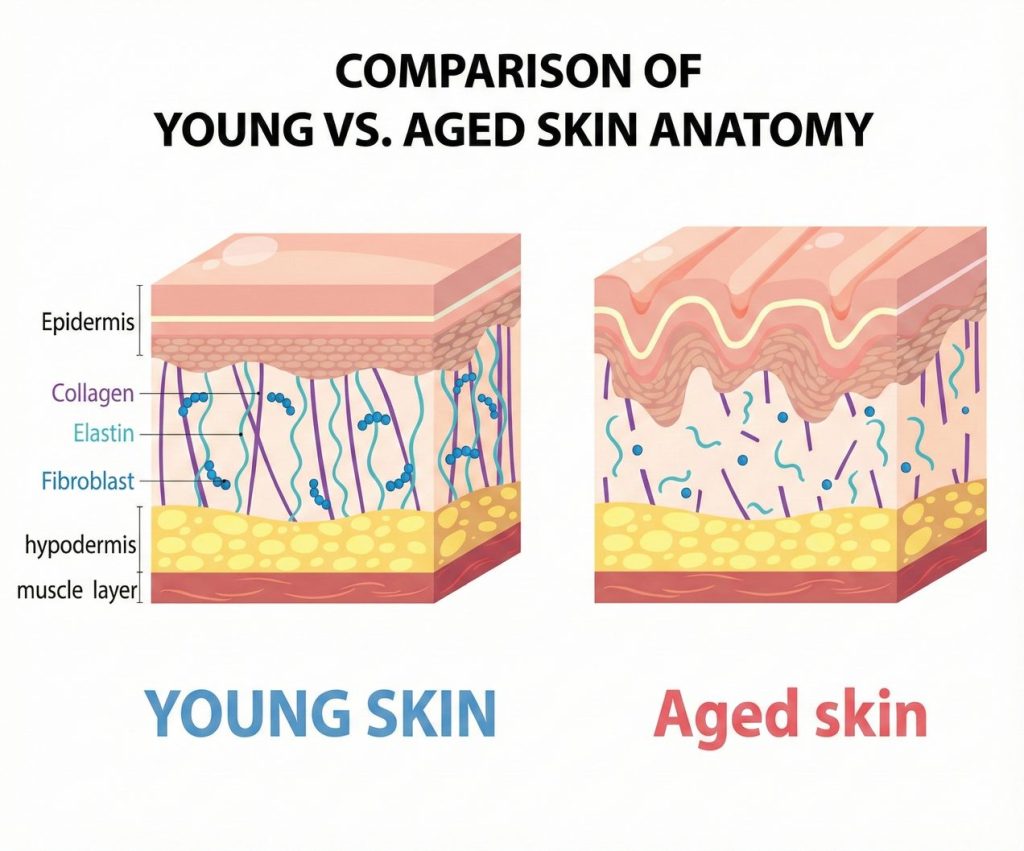
When you use a traditional filler, the gel occupies space. The duration of the result depends on how long it takes your body to metabolise that gel. PLLA is different. The PLLA micro-particles themselves degrade relatively quickly. However, their purpose is to stimulate fibroblasts to create Type I collagen. The “result” you see in the mirror is your own tissue. Therefore, the longevity depends on how long your own collagen lasts, which is inherently more durable than a synthetic gel.
The 25-Month Benchmark
Clinical studies, including pivotal trials published in the Journal of the American Academy of Dermatology, have established the “25-month” benchmark. This does not mean the results vanish on the first day of the 26th month. It means that significant aesthetic improvement is still measurable at this point. Because the degradation is gradual, the “end” of the result is a soft landing, not a sudden drop-off.
Phase 1: The “Cinderella Effect” (Days 1–5)
The first few days after treatment can be deceptive. We call this the “Cinderella Effect” because it looks beautiful, but it is destined to disappear quickly.
Immediate Satisfaction (The Water Carrier)
PLLA comes as a dry powder. To inject it, your doctor must reconstitute it with sterile water and lidocaine. When this mixture enters your skin, the water physically fills the hollows in your temples or cheeks. You will look plump, lifted, and refreshed immediately. This often gives patients a preview of their final result.
The Inevitable Disappearance
This is mostly water weight. Your body is extremely efficient at absorbing water. Within 48 to 72 hours, your system absorbs the fluid. As the water leaves, the volume subsides. This is normal and expected, but it can be psychologically jarring if you are not prepared for it.
Phase 2: The “Volume Gap” (Weeks 2–6)
This is the most challenging phase for patients. We sometimes refer to this as the “Valley of Disappointment.”
Why You Might Feel Disappointed
By week two, the water is gone, but the new collagen has not yet formed. You will likely look exactly as you did before you walked into the clinic. You might look in the mirror and think, “Did I just waste my money?” It is crucial to trust the process during this window.
What Is Happening Microscopically?
Rest assured, the PLLA particles are still there. They are currently lodging themselves in the deep dermis, acting as a scaffold. Your immune system is just beginning to identify them and send the “repair crew” (fibroblasts) to the site. This is a silent physiological process. No visible changes occur on the surface, but the biochemical foundation is being laid.
Phase 3: The Ascent (Months 3–6)
If you stay patient, this is where the magic happens. The curve starts to trend upward.
The “PLLA Glow” First
Usually, the first thing patients notice is not volume, but a change in skin quality often called the “PLLA Glow.” Around week 6 to 8, the skin may feel thicker, tighter, and more hydrated. This is because collagen affects the extracellular matrix, improving the skin’s ability to hold moisture and reflect light.
Structural Restoration
By month 3, the collagen accumulation becomes significant enough to create physical volume. The hollows in the temples begin to soften. The cheekbones appear more defined. Unlike the “water volume” from Phase 1, this volume feels firm and moves naturally with your facial expressions. This process continues to peak around month 6, assuming you have completed your recommended number of sessions (typically 2 to 3).
Phase 4: Long-Term Maintenance (Years 1–2)
PLLA is a marathon. Once you have achieved your desired correction, you enter the maintenance phase.
Do Results Stop Abruptly?
No. Aging is dynamic. Even as the PLLA-induced collagen persists, your skull is slowly resorbing, and your fat pads are shifting due to natural aging. The PLLA slows down the visual clock, but it doesn’t stop it. When the results fade, they do so gradually. You simply slowly return to your baseline, often with better skin quality than if you had never treated it.
The Maintenance Strategy
We generally recommend a “top-up” session once a year or every 18 months. You do not need to repeat the full initial series (e.g., 3 vials). Usually, a single vial is sufficient to boost collagen production and maintain the plateau of results.
Variables That Influence Your Timeline
The “25 months” is an average. Your individual mileage may vary based on several factors.
Metabolic Rate and Exercise
Patients with extremely high metabolisms (such as endurance athletes or marathon runners) often metabolise aesthetic products faster. While PLLA is more resistant to this than HA fillers, high metabolic activity can still shorten the duration of the collagen matrix.
Age and Fibroblast Health
A 35-year-old’s fibroblasts are more active than a 60-year-old’s. Older patients may require more vials initially to achieve the same result and might see a slightly shorter duration of effect due to slower cellular regeneration rates. For mature patients, we often combine PLLA with other modalities to support the skin from multiple angles.
Frequently Asked Questions
If I hate the results, can I reverse it?
No. Unlike Hyaluronic Acid, which can be dissolved with an enzyme called hyaluronidase, PLLA cannot be chemically reversed. You have to wait for the collagen to naturally break down. This is why we advocate for a conservative, gradual approach.
How many sessions does it take to see the full timeline?
Most patients need 2 to 3 sessions. The timeline we described above (peaking at 6 months) assumes you have completed your recommended course. If you stop after one session, you will see some improvement, but likely not the full potential.
Will I look “puffy” later on?
PLLA causes a reaction that grows tissue. If over-injected, it can create too much volume. However, because the growth is slow, your doctor can monitor your progress at each session and adjust the dosage. It is much harder to “accidentally” overfill with PLLA than with instant fillers.
Conclusion
The PLLA timeline is unique in aesthetic medicine. It requires a shift in mindset from “fixing” to “nurturing.” The initial disappearance of volume can be disheartening, but it is a necessary step in the process. By understanding the phases from the Cinderella Effect to the Volume Gap, and finally to the Structural Peak, you can approach the treatment with confidence.
You are not just filling a wrinkle; you are restoring the biological scaffolding of your face. The results are earned, and because of that, they endure.
Speak to us to design your personalised PLLA treatment plan.