Introduction
Deciding to undergo a Poly-L-Lactic Acid (PLLA) transformation is different from booking a standard facial or even a quick Botox appointment. PLLA Treatment plan Singapore is not a “lunchtime fix.” It is a project. Much like building a house, it requires a blueprint, a timeline, and a dedicated foundation.
In our central guide on PLLA Singapore: The Comprehensive Guide to Collagen Biostimulators, we explored the science of how this biostimulator works. But for the patient ready to take the next step, the questions become logistical: How many vials do I need? How many times do I have to come back? Does it make financial sense?
This guide serves as your logistical handbook. We will demystify the “Vial Per Decade” rule and help you construct a PLLA treatment plan in Singapore that aligns with your aesthetic goals and your schedule.
A standard PLLA treatment plan often follows the “Vial Per Decade” rule (e.g., a 40-year-old typically requires roughly 4 vials total). These vials are not injected all at once but are distributed across 2 to 3 sessions, spaced 4 to 6 weeks apart. Once the initial foundation is built, maintenance is low-intensity, typically requiring just one “top-up” session every 12 to 18 months.
Table of Contents
- The “Vial Per Decade” Rule: Estimating Your Dosage
- Scheduling Your Sessions: The 4-6 Week Gap
- Budgeting for PLLA: An Investment Perspective
- Pre-Treatment Checklist: Preparing for Success
- Post-Treatment Logistics: The 5-5-5 Commitment
- The Maintenance Phase: Protecting Your Investment
- Frequently Asked Questions
- Conclusion
The “Vial Per Decade” Rule: Estimating Your Dosage
One of the most common questions patients ask is, “How much product do I need?” Unlike Hyaluronic Acid (HA) fillers, where one syringe can make a visible difference in lips, PLLA requires a cumulative approach to build structural density.
Decoding the Math (Total vs. Per Session)
Doctors worldwide often use the “Vial Per Decade” rule as a baseline.
- 30s: ~3 Vials
- 40s: ~4 Vials
- 50s: ~5 Vials
Crucial Clarification: This is the total number of vials needed for your full correction, not the number of vials injected in a single afternoon. If you are 40, you might need 4 vials. Your doctor will likely split this into two sessions: 2 vials in the first visit, and 2 vials in the second visit six weeks later. Injecting too much at once can lead to aggressive inflammation or nodules, so we layer it gradually.
Adjusting for Volume Loss Severity
The rule is a starting point, not a law.
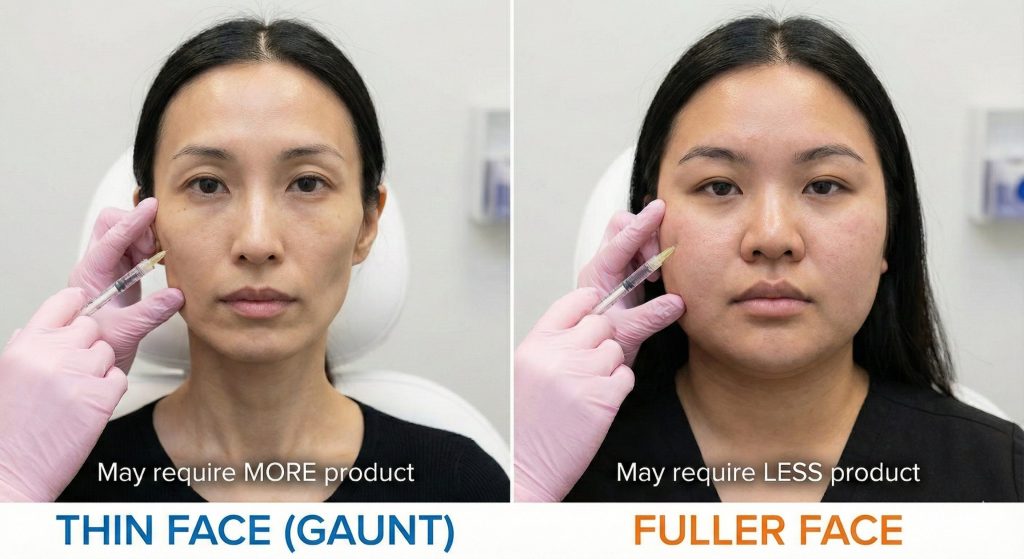
- Thin Faces: Runners or individuals with naturally low body fat (“gaunt” faces) often require more product than the rule suggests because they have less baseline tissue to support the skin.
- Fuller Faces: Patients with thicker skin or more residual fat might require less product to achieve a lifted look.
Scheduling Your Sessions: The 4-6 Week Gap
Patience is the currency of PLLA. You cannot rush biology.
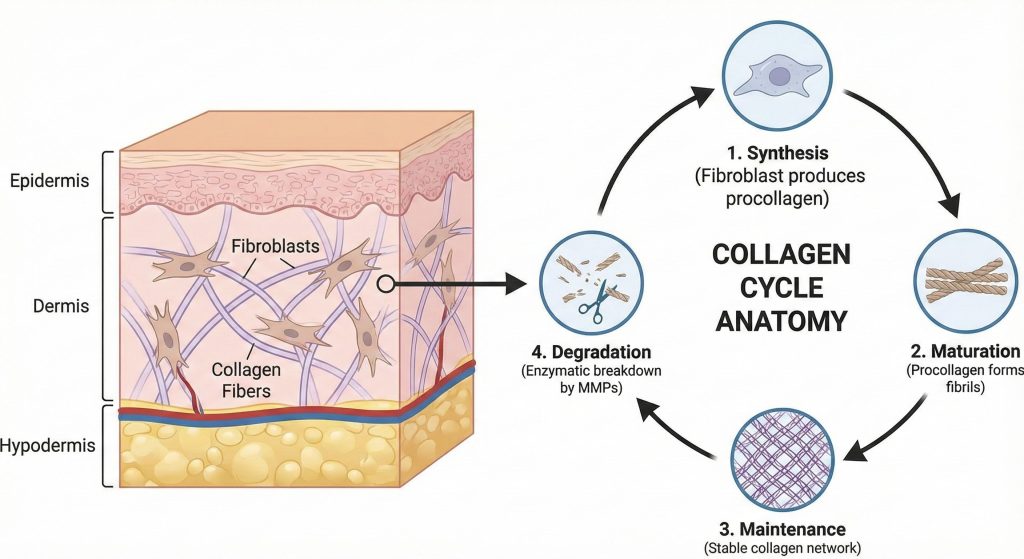
Why We Wait (The Collagen Cycle)
We typically space sessions 4 to 6 weeks apart. Why? Because at 4 weeks, the initial inflammatory response has settled, and the early collagen production is just beginning. This allows the doctor to see how your skin is reacting. If we inject too soon, we are “flying blind,” layering new product on top of tissue that hasn’t finished responding to the first dose.
What Happens if You Wait Too Long?
If you wait 3 months between sessions, it isn’t dangerous, but it is inefficient. You lose the momentum of the stimulation. Ideally, you want to stack the stimulation waves to maximize fibroblast activity.
Budgeting for PLLA: An Investment Perspective
It is important to address the financial aspect transparently. In Singapore, a vial of PLLA typically ranges from $1,000 to $1,500. When you multiply that by 4 or 5 vials, the upfront cost is higher than a standard filler appointment.
Upfront Cost vs. Long-Term Value
However, PLLA often wins on “cost-per-month” value.
- HA Fillers: You might spend $800-$1000 every 6-9 months to maintain a lifted look. Over two years, this adds up significantly.
- PLLA: You pay a higher sum upfront for the initial series. But once completed, the results endure for 25 months or longer. When amortised over two years, the monthly cost is often comparable to or lower than maintaining high-quality HA fillers.
Comparing PLLA to HA Maintenance Costs
Think of HA fillers like renting an apartment (you pay frequently to stay). PLLA is like buying the house (a large down payment, but then you own the structure for a long time).
Pre-Treatment Checklist: Preparing for Success
To get the best results and minimise “social downtime,” preparation starts days before you enter the clinic.
Medications and Supplements to Pause
PLLA involves multiple injection points, which increases the risk of bruising. To minimise this:
- Avoid: Aspirin, NSAIDs (Ibuprofen), Vitamin E, Fish Oil, and Gingko Biloba for 5-7 days prior. These thin the blood.
- Alcohol: Avoid alcohol for 24 hours before your appointment to reduce swelling potential.
Timing Your Social Calendar
While you can return to work immediately, you will likely look “puffy” for 24-48 hours due to the sterile water carrier. Do not schedule your first session two days before a major event (like a wedding or photoshoot). Give yourself a 5-day buffer to look your best.
Post-Treatment Logistics: The 5-5-5 Commitment
We cannot emphasise this enough: the success of your treatment plan depends on you.
Why You Cannot Outsource the Massage
Your doctor places the product, but you ensure it stays smooth. The 5-5-5 Rule (Massage 5 minutes, 5 times a day, for 5 days) is mandatory.
- The Risk: If you skip this, the PLLA particles may clump together, forming palpable nodules.
- The Technique: Your doctor will demonstrate firmly massageing the treated areas (usually temples and cheeks) using a moisturiser. It should feel like a deep tissue massage, not a light caress.
The Maintenance Phase: Protecting Your Investment
Once you finish your initial series (e.g., 2 or 3 visits), you enter the “Maintenance Phase.”
The “Top-Up” Schedule (Year 1 and Beyond)
You do not need to repeat the “Vial per Decade” rule ever again. To maintain your results, we recommend one single vial once a year. Think of this like servicing a car. You don’t replace the engine every year; you just change the oil to keep it running smoothly. This single annual session keeps your collagen factories active and combats the ongoing ageing process.
Frequently Asked Questions
How do I schedule PLLA if I am also doing Ultraformer, Skinboosters, or Hydrafacial?
Since PLLA requires a specific “5-5-5” massage protocol post-treatment, the timing of your other appointments is critical to ensure you don’t displace the product or irritate the skin. Here is the typical sequencing logic we use to build your plan:
- Ultraformer (HIFU): Timing is key here. We generally recommend performing Ultraformer before your PLLA injection (even in the same session is possible for many). If you have already injected PLLA, we usually advise waiting 3 months before applying high-intensity focused ultrasound to the same area to ensure the PLLA particles are fully integrated.
- Hydrafacial: Deep cleansing is great for skin prep. You can safely have a Hydrafacial immediately before your injection. However, if you want it after, you must wait at least 2 weeks. This gap is necessary because the suction and pressure of the facial could interfere with the PLLA placement or irritate the injection points before they heal.
- Skinboosters: These are excellent for surface hydration while PLLA works on deep structure. We often alternate them. For example, you might do PLLA in Month 1, Skinboosters in Month 2, and your second PLLA session in Month 3. This keeps the skin stimulated at different depths without overwhelming it.
- Botox: This is the easiest to combine. Since Botox creates no volume and requires no massage, it can typically be administered in the same appointment, often immediately after your PLLA injections are finished.
What if I can only afford 1 vial now?
While 1 vial is better than nothing, it is rarely enough to see a visible shift in global volume for an adult. It is often better to save up for the full protocol (at least 2 vials) to ensure you see the “Wow” factor. Using too little product can lead to disappointment, not because the product failed, but because the dose was insufficient.
Do I need a consultation first?
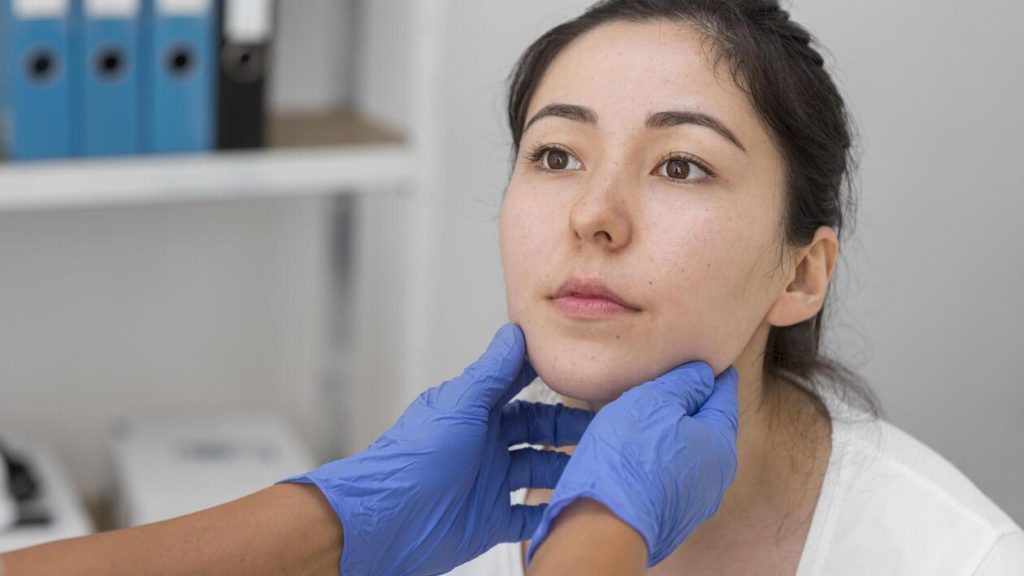
Absolutely. PLLA is not for everyone. If you have active skin infections or a history of keloid scarring, your plan will change. A face-to-face assessment is the only way to determine your exact vial count.
Medical Disclaimer: The treatment sequencing advice provided above is a general guideline for educational purposes. Individual skin responses and recovery times vary. Your doctor may adjust this timeline based on your specific healing progress and medical history. Always prioritize your physician’s specific post-care instructions over general online advice.
Conclusion
A successful PLLA treatment plan is a partnership between the physician’s strategy and the patient’s compliance. It requires a shift in perspective, moving away from the “quick fix” mentality toward a disciplined, long-term approach to tissue health.
By understanding the math behind the vials, respecting the 4-6 week intervals, and committing to the aftercare, you are setting yourself up for the most natural, durable results modern aesthetics can offer.
Speak to us to design your personalised PLLA treatment plan.