Introduction
In the landscape of medical aesthetics, a significant shift is occurring. For years, the standard approach to aging was simply to “fill” lines and wrinkles. While effective, this often addressed the symptom rather than the cause. Today, discerning patients in Singapore are moving toward “regenerative aesthetics” treatments that encourage the body to repair itself.
Poly-L-Lactic Acid (PLLA), commonly known by the brand name Sculptra, sits at the forefront of this movement. It is not a quick fix; it is a long-term investment in your skin’s structural integrity. This guide serves as your central resource for understanding PLLA treatment in Singapore, covering the science, the benefits, and the essential considerations before you begin.
PLLA (Poly-L-Lactic Acid) is a bio-compatible, synthetic injectable that functions as a collagen stimulator. Unlike hyaluronic acid fillers that provide immediate volume, PLLA works by stimulating the body’s own fibroblasts to produce Type I collagen over several months. This results in gradual, natural-looking volume restoration and improved skin quality that can last more than two years.
Table of Contents
- What Is PLLA and How Does It Work?
- Restoring the Foundation: Treatable Areas
- The Timeline: Patience for Perfection
- Safety Profile and Side Effects
- Designing Your Treatment Plan
- Frequently Asked Questions
- Conclusion
What Is PLLA and How Does It Work?
To understand PLLA, you must first unlearn what you know about traditional fillers. Most fillers are gels made of Hyaluronic Acid (HA) that physically occupy space under the skin. If you imagine your skin as a tent, HA fillers are like adding a new pole to prop it up instantly.
PLLA, however, acts more like a “fertiliser” for the tent’s fabric. It is a synthetic substance (originally used in dissolvable sutures) that acts as a biostimulator.
The Biochemistry of Biostimulation (Simplified)
When injected, PLLA micro-particles are suspended in water. This water absorbs within a few days, but the micro-particles remain. Your body detects these particles and initiates a mild, controlled healing response. This response recruits fibroblasts, the cells responsible for building the extracellular matrix to encapsulate the particles with fresh, new collagen. Over time, the PLLA degrades into lactic acid and is exhaled as CO2, leaving behind a reinforced network of your own tissue.
PLLA vs. Traditional HA Fillers
The choice between PLLA and HA depends on your goals:
- HA Fillers: Best for immediate gratification, specific contouring (like lips or nose), and superficial hydration.
- PLLA: Best for global volume loss, long-term structural support, and patients who prefer gradual, undetectable changes.
Restoring the Foundation: Treatable Areas
PLLA is rarely used to chase individual wrinkles. It is designed for “pan-facial” or global rejuvenation. By targeting the deep structural planes of the face, it addresses the hollowing and laxity that contribute to an aged appearance.
Global Volume Replacement
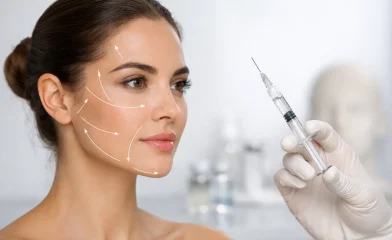
Common treatment zones include the temples, cheeks, jawline, and pre-auricular (in front of the ear) region. Treating these areas helps to re-drape the skin, subtly lifting the lower face and reducing the appearance of nasolabial folds and marionette lines. It is an architecture-first approach to beauty.
Not all areas of the face are suitable for this treatment. To understand exactly where this biostimulator excels and where it should be avoided, read our specific guide on PLLA face contouring.
The Timeline: Patience for Perfection
One of the most defining characteristics of PLLA is the delay in results. This is often a “pro” for patients wanting discretion, but it can be a “con” for those wanting instant fixes.
Why Results Are Not Immediate
Because PLLA relies on your body’s biological machinery to produce collagen, the results appear on a biological timeline. You will likely look “filled” for 24 hours due to the water in the injection, return to baseline for a few weeks, and then slowly see the “PLLA Glow” and volume emerge from week 4 onwards.
Managing your expectations regarding the “glow” versus the “volume” is crucial. For a full breakdown of the weeks and months following your injection, view the PLLA timeline of what to expect.
Safety Profile and Side Effects
PLLA has been used worldwide since 1999 and has a robust safety profile. However, like any medical procedure, it carries specific risks that are distinct from HA fillers.
Understanding the Risks
The most unique risk associated with PLLA is the formation of nodules, small, non-visible bumps under the skin. These typically occur if the product is not diluted correctly or if the patient fails to perform the necessary post-treatment massage. Unlike HA fillers, PLLA cannot be dissolved with an enzyme if you are unhappy with the result, which emphasises the need for a skilled provider.
Before scheduling your appointment, it is vital to understand the difference between common side effects (like bruising) and adverse events. Read our safety briefing on PLLA side effects.
Designing Your Treatment Plan
PLLA is not a “one and done” treatment. It functions more like a course of antibiotics or a vaccination series, you need the full protocol to see the intended effect.
Sessions, Vials, and Maintenance
A general rule of thumb used by many practitioners is “one vial per decade of life” (e.g., 3 vials for a 30-year-old), though this varies significantly based on individual volume loss. These vials are usually split across 2 to 3 sessions spaced 4 to 6 weeks apart.
Calculating the right dosage and understanding the financial commitment is key to a successful outcome. Learn more about how we structure your journey in our guide to PLLA Treatment Planning 101.
Frequently Asked Questions
Is PLLA safe for all skin types?
Yes, PLLA is generally safe for all skin types. Since it is synthetic, there is no risk of allergic reaction to the material itself, and it does not cause pigmentation issues often seen with laser resurfacing.
Does it hurt?
PLLA is mixed with lidocaine (an anesthetic) before injection, making the procedure relatively comfortable. Most patients report feeling pressure rather than sharp pain.
Can I look natural with PLLA?
Absolutely. In fact, PLLA is renowned for delivering the most natural-looking results of any injectable because the volume created is your own tissue, not a foreign gel.
Conclusion
PLLA represents the sophisticated evolution of aesthetic medicine in Singapore. It moves beyond the simple filling of lines to the actual regeneration of youthfulness. By stimulating your own collagen, it offers a solution that is durable, natural, and harmonious with your unique facial structure.
While it requires patience and a commitment to the process, the reward is a refreshed version of yourself that stands the test of time.
Speak to us to design your personalised PLLA treatment plan.