Introduction
When we look in the mirror and see ageing, we often point to specific lines: the “brackets” around the mouth or the “worry lines” on the forehead. The instinct is to fill that specific line. However, PLLA (Poly-L-Lactic Acid) challenges this approach. It operates on the principle that a sagging face is usually the result of a collapsing foundation, not just surface wrinkles.
As detailed in our central guide on PLLA Singapore: The Comprehensive Guide to Collagen Biostimulators, this treatment is a structural investment. But where exactly should you place this investment? In this guide, we map out the specific territories of the face where PLLA excels at PLLA face contouring, and equally importantly, the “danger zones” where it should never be placed.
PLLA is most effective for large surface areas that require structural volume restoration. The primary treatment zones are the temples, cheeks (mid-face), jawline, and nasolabial folds. It provides a “global” lift by restoring deep volume loss. However, it is not suitable for high-mobility areas like the lips or thin-skinned areas like the tear troughs (under-eyes), where traditional hyaluronic acid fillers remain the gold standard.
Table of Contents
- The “Liquid Facelift” Concept: Restoring the Frame
- The Upper Face: Opening the Eyes
- The Mid-Face: The Powerhouse of Youth
- The Lower Face: Defining Boundaries
- The “No-Go” Zones: Where PLLA Should Never Be Used
- Combining PLLA with Other Modalities
- Frequently Asked Questions
- Conclusion
The “Liquid Facelift” Concept: Restoring the Frame
PLLA is rarely used to “spot treat” a single wrinkle. Instead, it is the foundation of the “Liquid Facelift.”
Why PLLA Is an Anchor, Not a Surface Smoother
Think of your face like a bed. The mattress is the deep fat and bone, and the bedsheet is your skin. As you age, the mattress shrinks (bone resorption and fat loss), causing the sheet (skin) to bunch up and sag. PLLA restores the size of the “mattress” by regenerating collagen deep down. By re-inflating the underlying structure, the skin naturally re-drapes and tightens.
The Upper Face: Opening the Eyes
Ageing in the upper face often looks like “skeletonisation” where the skull shape becomes too visible.
Sunken Temples (The Hidden Age Indicator)
The temples are often neglected, yet hollowing here causes the brow to drop and gives the face a “peanut” shape (wide forehead, narrow temples, wide cheeks).
- The PLLA Solution: Injecting PLLA into the temporal fossa fills this concavity. The result is a smoother transition from the eye to the hairline, which subtly lifts the tail of the eyebrow and “opens” the eyes.

The Brow Frame
Loss of bone density above the brow can make the forehead look flat or uneven. Placing small amounts of PLLA along the supraorbital rim can provide structural support to the forehead skin, reducing the appearance of horizontal lines without freezing the muscle like Botox.
The Mid-Face: The Powerhouse of Youth
The mid-face is the anchor for the rest of the face. If you lose volume here, everything below it (jowls, mouth corners) starts to sag.
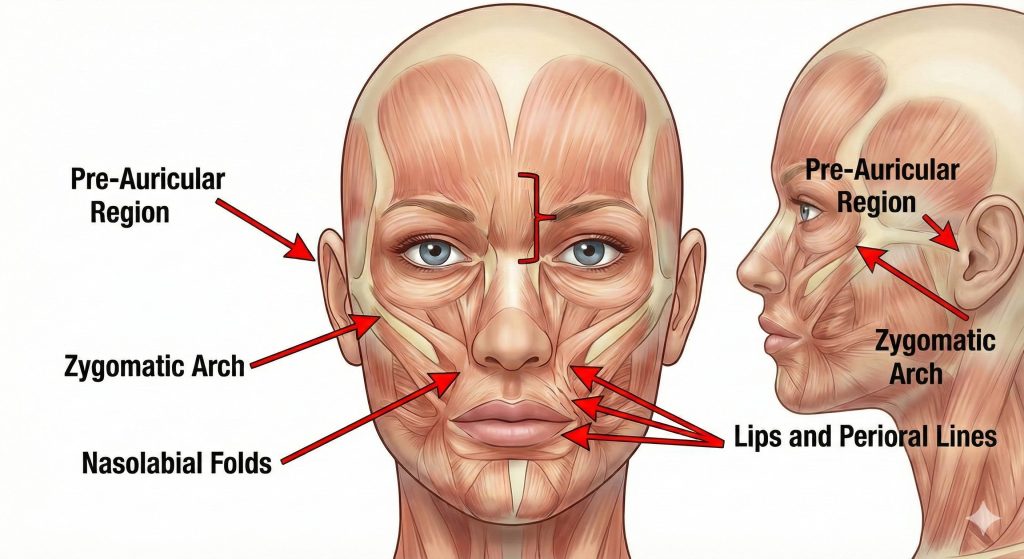
Cheeks and Zygomatic Arch (Lifting the Lower Face)
This is the most common treatment area. As cheek fat pads descend, the face looks tired.
- The PLLA Solution: By placing PLLA along the cheekbone (zygomatic arch), we rebuild the apex of the cheek. This creates a “vector of lift,” pulling the skin of the lower face upwards and backwards, restoring the “Ogee curve” (the youthful S-curve of the cheek).
Pre-Auricular Region (The Area in Front of Ears)
Touch the area right in front of your ears. Is it loose? Volume loss here contributes to the “accordion” wrinkling on the cheeks when you smile. PLLA strengthens this lateral anchor point, effectively tightening the skin back toward the ears.
The Lower Face: Defining Boundaries
A youthful face has a sharp division between the face and the neck. ageing blurs this line.
Jawline Contouring and Chin
A weak jawline can be genetic or age-related.
- The PLLA Solution: PLLA can be used to sculpt a stronger, more defined jawline angle. By thickening the skin and adding volume along the mandible, it camouflages early jowl formation and creates a sharper profile. It is also effective for chin projection, balancing the side profile.
Nasolabial Folds and Marionette Lines
These are the deep creases running from nose to mouth, and mouth to chin.
- The PLLA Solution: While Hyaluronic Acid (HA) fillers fill the crease directly, PLLA is often used to support the surrounding area. By thickening the dermis around these folds, we soften their appearance naturally without creating a “puffy” monkey-mouth look.

The “No-Go” Zones: Where PLLA Should Never Be Used
Knowing where not to inject is a sign of an expert provider. PLLA causes tissue growth, so it must be avoided in areas where bulk is undesirable or where the skin is too thin to hide the product.
Lips and Perioral Lines (Kissing Lines)
Never put PLLA in the lips. The lips are a high-mobility muscle zone. The constant movement would clump the PLLA particles, causing permanent lumps (nodules). For lip volume, HA fillers are the only safe option.
The Glabella (Frown Lines) and Under-Eyes
- Glabella (between eyebrows): High risk of vascular complications (blindness) and nodule formation.
- Tear Troughs (Under-eyes): The skin here is paper-thin. Placing PLLA here poses a high risk of visible lumps. HA fillers are preferred for this delicate area.
Combining PLLA with Other Modalities
Because PLLA has “off-limits” zones, it is rarely a solo act.
PLLA + HA Fillers (The Hybrid Approach)
This is a powerful combination. We use PLLA for the “frame” (Temples, Cheeks, Jawline) to provide long-term lift and structure. Then, we use HA fillers for the “finesse” work for plumping the lips, smoothing under-eye hollows, or filling very fine superficial lines that PLLA cannot address.
Frequently Asked Questions
Can PLLA be used on the body?
Yes. “Sculptra Butt Lift” and hip dip corrections are popular off-label uses. However, because the body requires much more volume than the face, the cost is significantly higher.
Will PLLA make my face look fat?
This is a common fear. The answer is no, provided the dosage is correct. PLLA restores lost volume; it doesn’t add new fat. It brings you back to where you were 5 or 10 years ago, rather than changing your fundamental face shape.
How do I know if I need PLLA or a Facelift?
PLLA treats volume loss. A facelift treats skin laxity (excess skin). If you have significant hanging skin (turkey neck), PLLA alone will not be enough; you may need surgery. However, for mild to moderate laxity combined with hollowing, PLLA is an excellent non-surgical alternative.
Conclusion
PLLA face contouring is about seeing the forest, not the trees. It steps back to look at the overall harmony and balance of the face rather than obsessing over a single wrinkle. By strategically reinforcing the temples, cheeks, and jawline, it re-establishes the structural pillars of youth.
If you are looking to address the “tired” look that makeup can’t hide, restoring your foundation is the most effective step forward.
Speak to us to design your personalised PLLA treatment plan.