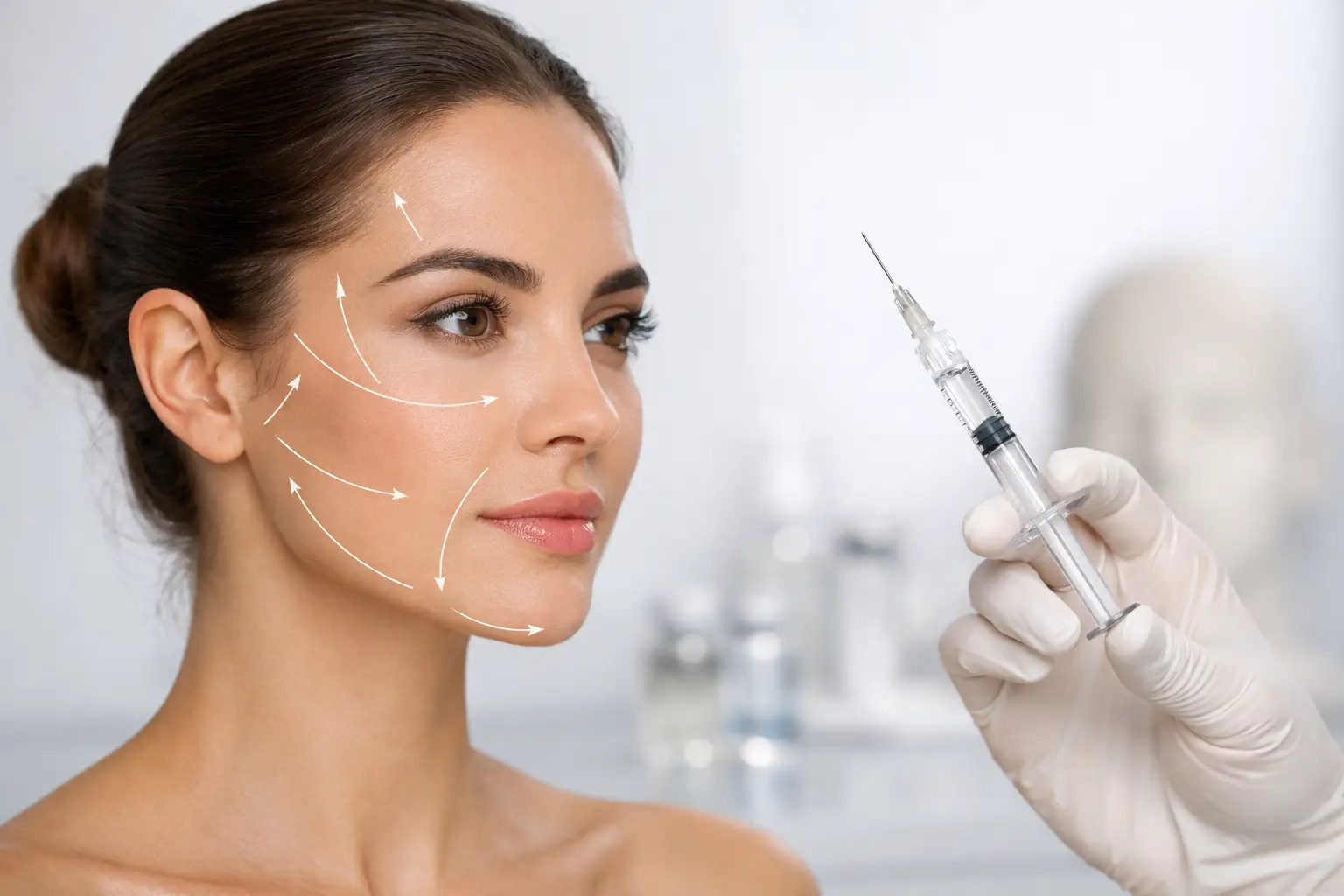
The lines that run from the sides of the nose down towards the corners of the mouth have a friendly name — smile lines — but most people notice them with anything but delight. They are among the earliest changes patients ask about, and among the most commonly mistreated. If you have been considering smile lines filler, the most useful thing to understand first is that the fold itself is often not the real problem.
What Smile Lines and Nasolabial Folds Actually Are
The nasolabial fold is a natural anatomical crease that separates the cheek from the upper lip. Everyone has one — it forms where the muscles that lift the corner of the mouth attach to the overlying skin. The concern is not its existence but its depth: when the fold becomes visible at rest rather than only in expression.
Why They Deepen: It Usually Starts Above the Fold
Here is the part that surprises people. A deepening smile line is frequently a symptom of change in the mid-face, not the fold itself. As the cheek loses volume and its supporting fat descends slightly, tissue gathers just above the fold and the crease is pushed into greater prominence.
In other words, the line often deepens because the cheek above it has lost support. This pattern is particularly relevant in Asian facial structure, where flatter mid-face projection and a broader bony base mean that even modest cheek descent can make the fold appear more prominent — one reason a treatment plan built for one face type does not transfer neatly to another. We explain the underlying mechanics — bone, fat and skin — in understanding facial volume loss.

Why Filling the Crease Directly Can Look Wrong
If the cause sits above the fold, treating only the fold is treating the symptom. Injecting a large amount of product directly into a deep crease can create a heavy, over-full look around the mouth, and in some cases makes the area appear more prominent rather than less.
This is why an experienced injector reads the whole mid-face before deciding where anything should go. Sometimes the crease is softened best by restoring quiet support to the cheek — and only then, if needed, refining the fold itself with a small, conservative amount.
The Structural Approach: Support First
Restoring gentle support to the mid-face can lift tissue away from the fold and soften it indirectly. Depending on your anatomy and goals, that support may come from a cheek filler or mid-face filler approach, placed with restraint rather than volume for its own sake.
Smile Lines Filler or Collagen Biostimulator: Which Suits You?
These are different tools for different problems. A hyaluronic acid gel filler adds volume immediately where it is placed, which suits targeted structural support. A collagen biostimulator works gradually, encouraging your own collagen to rebuild overall density across the area rather than filling a single point.
For a broad loss of support across the mid-face, the gradual route often looks more natural. Our comparison of Sculptra vs. traditional fillers explains the trade-off, PLLA for volume loss covers which areas respond well, and we compare the individual products in our guide to Sculptra, Loviselle and PCL.

When Skin Laxity Is Part of the Picture
If loose skin is contributing, adding volume alone will not solve it. Tightening treatments address firmness rather than volume, and the two are often planned together — a distinction we set out in our guide to non-surgical face lifting with Ultraformer MPT.
Risks and Suitability
Dermal fillers are medical treatments and carry real risks. Common effects include bruising, swelling and tenderness for a few days. Less commonly there can be lumpiness or asymmetry, and rarely a vascular occlusion, where product affects a blood vessel — a recognised complication in the mid-face that requires prompt medical management. Filler is generally avoided in pregnancy and breastfeeding, with active infection at the site, and in some autoimmune or bleeding conditions. A proper consultation should cover your medical history and the specific risks for the area being treated.
Keeping Results Natural
The goal is not to erase the fold. A face with no nasolabial line at all does not look younger — it looks unusual. Good treatment softens the crease so it reads as a smile line again rather than a permanent feature, while your expression stays entirely your own. In Singapore’s humidity, where skin is often treated more lightly than in drier climates, that restrained approach tends to age better than aggressive correction. Choosing a clinic that plans conservatively matters; our 5 signs of a reliable aesthetic clinic is a useful checklist.
The Bottom Line
Smile lines are best treated by understanding why they deepened rather than by filling them in. For most people that means restoring support above the fold, choosing the right tool for the job, and accepting that softer — not gone — is the natural-looking goal.
Wondering what is driving your smile lines? Book a consultation for a personalised assessment of your mid-face and a plan built around your anatomy.


 100vw, 1500px" /></figure>
<h2>Why Filling the Crease Directly Can Look Wrong</h2>
<p>If the cause sits above the fold, treating only the fold is treating the symptom. Injecting a large amount of product directly into a deep crease can create a heavy, over-full look around the mouth, and in some cases makes the area appear more prominent rather than less.</p>
<p>This is why an experienced injector reads the whole mid-face before deciding where anything should go. Sometimes the crease is softened best by restoring quiet support to the cheek — and only then, if needed, refining the fold itself with a small, conservative amount.</p>
<h2>The Structural Approach: Support First</h2>
<p>Restoring gentle support to the mid-face can lift tissue away from the fold and soften it indirectly. Depending on your anatomy and goals, that support may come from a <a href="https://asimontclinic.com/medical-aesthetic/cheek-filler/">cheek filler</a> or <a href="https://asimontclinic.com/medical-aesthetic/mid-face-filler/">mid-face filler</a> approach, placed with restraint rather than volume for its own sake.</p>
<h2>Smile Lines Filler or Collagen Biostimulator: Which Suits You?</h2>
<p>These are different tools for different problems. A hyaluronic acid gel filler adds volume immediately where it is placed, which suits targeted structural support. A collagen biostimulator works gradually, encouraging your own collagen to rebuild overall density across the area rather than filling a single point.</p>
<p>For a broad loss of support across the mid-face, the gradual route often looks more natural. Our comparison of <a href="https://asimontclinic.com/sculptra-vs-traditional-fillers/">Sculptra vs. traditional fillers</a> explains the trade-off, <a href="https://asimontclinic.com/plla-for-volume-loss-which-areas-can-be-treated-and-how-effective-is-it/">PLLA for volume loss</a> covers which areas respond well, and we compare the individual products in our guide to <a href="https://asimontclinic.com/collagen-biostimulator-sculptra-loviselle-pcl/">Sculptra, Loviselle and PCL</a>.</p>
<figure class="wp-block-image size-large"><img decoding="async" width="1500" height="1001" src="https://asimontclinic.com/wp-content/uploads/2026/06/796-2.webp" alt="Softly refreshed mid-face with naturally softened smile lines" class="wp-image-2949" srcset="https://asimontclinic.com/wp-content/uploads/2026/06/796-2.webp 1500w, https://asimontclinic.com/wp-content/uploads/2026/06/796-2-300x200.webp 300w, https://asimontclinic.com/wp-content/uploads/2026/06/796-2-1024x683.webp 1024w, https://asimontclinic.com/wp-content/uploads/2026/06/796-2-768x513.webp 768w, https://asimontclinic.com/wp-content/uploads/2026/06/796-2-543x362.webp 543w, https://asimontclinic.com/wp-content/uploads/2026/06/796-2-392x262.webp 392w" sizes="(max-width: 1500px) 100vw, 1500px" /></figure>
<h2>When Skin Laxity Is Part of the Picture</h2>
<p>If loose skin is contributing, adding volume alone will not solve it. Tightening treatments address firmness rather than volume, and the two are often planned together — a distinction we set out in our guide to <a href="https://asimontclinic.com/hifu-singapore-non-surgical-face-lifting/">non-surgical face lifting with Ultraformer MPT</a>.</p>
<h2>Risks and Suitability</h2>
<p>Dermal fillers are medical treatments and carry real risks. Common effects include bruising, swelling and tenderness for a few days. Less commonly there can be lumpiness or asymmetry, and rarely a vascular occlusion, where product affects a blood vessel — a recognised complication in the mid-face that requires prompt medical management. Filler is generally avoided in pregnancy and breastfeeding, with active infection at the site, and in some autoimmune or bleeding conditions. A proper consultation should cover your medical history and the specific risks for the area being treated.</p>
<h2>Keeping Results Natural</h2>
<p>The goal is not to erase the fold. A face with no nasolabial line at all does not look younger — it looks unusual. Good treatment softens the crease so it reads as a smile line again rather than a permanent feature, while your expression stays entirely your own. In Singapore’s humidity, where skin is often treated more lightly than in drier climates, that restrained approach tends to age better than aggressive correction. Choosing a clinic that plans conservatively matters; our <a href="https://asimontclinic.com/5-signs-youve-found-a-reliable-aesthetic-clinic-in-singapore/">5 signs of a reliable aesthetic clinic</a> is a useful checklist.</p>
<h2>The Bottom Line</h2>
<p>Smile lines are best treated by understanding why they deepened rather than by filling them in. For most people that means restoring support above the fold, choosing the right tool for the job, and accepting that softer — not gone — is the natural-looking goal.</p>
<p><strong>Wondering what is driving your smile lines?</strong> <a href="https://asimontclinic.com/get-in-touch/">Book a consultation</a> for a personalised assessment of your mid-face and a plan built around your anatomy.</p>
)