Introduction
Gravity affects us all eventually. You might notice your jawline isn’t as sharp as it used to be, or perhaps the skin around your cheeks feels a little looser than you’d like. For years, the only real solution to significant sagging was going under the knife. But medical aesthetics has moved forward. Today, you can achieve noticeable lifting and tightening without a single incision.
This brings us to High-Intensity Focused Ultrasound. It is widely considered the gold standard for non-invasive facelifts in Singapore. If you are looking for a comprehensive overview of how this technology fits into a broader anti-ageing plan, you might want to start with our main page on Ultraformer MPT HIFU Treatment to understand the fundamentals. But if you are ready to get specific about what this treatment entails, the costs involved, and the results you can expect locally, you are in the right place.
What is HIFU?
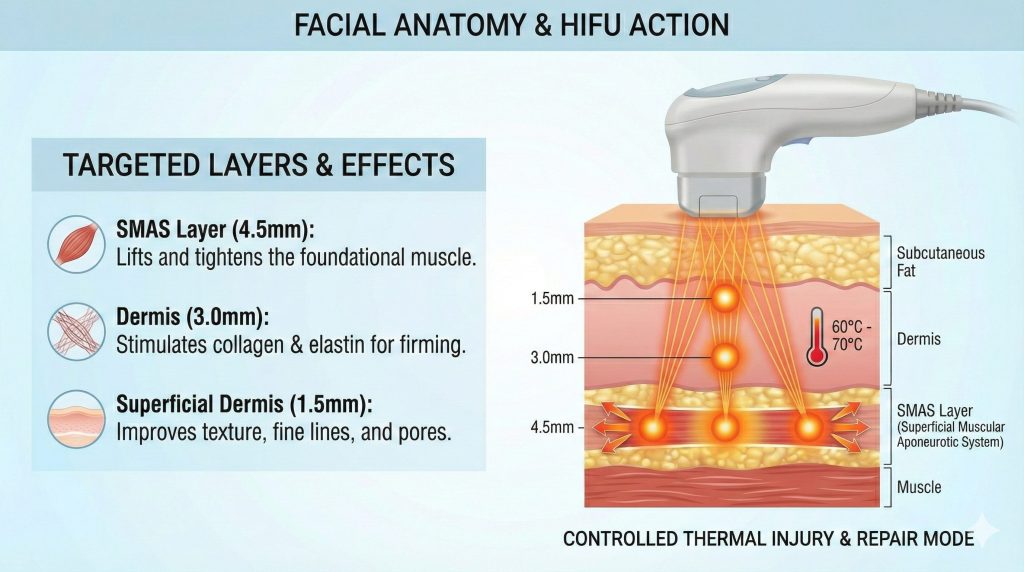
High-Intensity Focused Ultrasound (HIFU) is a non-invasive medical treatment that uses precise ultrasound energy to heat deep skin layers, specifically the SMAS layer. This thermal energy triggers a natural healing response, stimulating the production of new collagen and elastin to lift, tighten, and contour the face over 3 to 6 months.
Table of Contents
- Understanding HIFU Technology
- Evolution of the Tech: Standard vs. Ultraformer MPT
- What to Expect During the Procedure
- Realistic Results and Timelines
- Cost of HIFU in Singapore
- Safety Profile and Side Effects
- Frequently Asked Questions
- Conclusion
Understanding HIFU Technology
To appreciate why this treatment works, we have to look beneath the surface of the skin. Most topical creams and serums sit on the epidermis (the top layer). They are great for texture and hydration, but they cannot address structural sagging.
How Focused Ultrasound Works
Think of using a magnifying glass to focus sunlight onto a leaf. The glass concentrates the light into a single, hot point without burning the air around it. HIFU works on a similar principle. It bypasses the surface of your skin entirely, delivering focused ultrasound energy to specific depths, usually 1.5mm, 3.0mm, and 4.5mm.
When this energy hits the target tissue, it heats it to between 60°C and 70°C. This specific temperature range is vital. It causes “thermal coagulation points,” which essentially means it creates tiny, controlled injuries. Your body recognises this as damage and immediately kicks into repair mode.
Targeting the SMAS Layer
The real magic happens at the 4.5mm depth. This is where the Superficial Muscular Aponeurotic System (SMAS) lives. If you were to have a traditional surgical facelift, a surgeon would physically cut, pull, and stitch this layer to tighten the face.
HIFU is unique because it is one of the only non-surgical devices capable of reaching the SMAS. By heating and tightening this layer directly, you get a foundational lift that supports the skin layers above it.
Evolution of the Tech: Standard vs. Ultraformer MPT
Not all machines are created equal. In Singapore, you will likely encounter a few different brands, but the technology has shifted significantly in recent years. It is common for patients to compare different lifting modalities before choosing. If you are weighing your options, you might find our comparison on HIFU vs Ultherapy vs Thread Lift – Which Non-Surgical Lift Is Best Suited for You?
Why the Equipment Matters
Older generations of ultrasound devices were effective, but they had drawbacks. They were often quite painful, with patients describing the sensation as a “deep bone ache” or “electric shocks.” They also took a long time to perform.
The MPT Difference
Newer systems, specifically the Ultraformer MPT (Micro-Pulsed Technology), have changed the patient experience. While traditional devices deliver energy in a series of dots (like a dotted line), the MPT system can deliver energy in a continuous line.
This matters for two reasons:
- Density: It creates a denser thermal effect, which can lead to better collagen stimulation.
- Speed and Comfort: The continuous delivery is much faster. Because the energy is delivered rapidly, the nerves have less time to register pain signals.
So, you get a more intensive treatment in less time, with significantly less discomfort.
What to Expect During the Procedure
If you decide to proceed, knowing exactly what happens in the clinic room helps reduce anxiety. For a deep dive into the sensory experience and recovery, read our detailed guide: Is HIFU Painful? The Truth About Discomfort, Recovery and Downtime
Preparation and Numbing
First, the aesthetician will cleanse your face thoroughly. Even though modern systems like the Ultraformer MPT are more comfortable, most clinics in Singapore will apply a topical numbing cream. This usually sits on the skin for about 15 to 30 minutes to ensure you are as relaxed as possible.
The Treatment Experience
Once the numbing cream is removed, a conductive ultrasound gel is applied to your face. The doctor will then place the handheld device against your skin.
You might feel a warm sensation or a slight prickling feeling. Areas near the bone, like the jawline or forehead, tend to be more sensitive than the cheeks. The doctor will adjust the intensity based on your feedback. A full-face session typically takes 30 to 45 minutes.
Post-Treatment Downtime
This is often called a “lunchtime procedure” for a reason. Unlike lasers that might leave you peeling, or microneedling that leaves you red and bloody, HIFU leaves the surface of the skin intact.
You might look slightly flushed (pink) immediately after, but this usually subsides within a few hours. You can apply makeup and return to work or social activities right away.
 Realistic Results and Timelines
 Realistic Results and Timelines
Manageing expectations is the key to satisfaction with any aesthetic procedure. A common question patients have is regarding the longevity of the lift. For a detailed timeline, check out How Long Does HIFU Last? What to Expect After Your First Session
Immediate vs. Long-Term Lifting
You might see a slight lift immediately after the session. But don’t be fooled—this is mostly due to mild swelling and thermal contraction. The real results take time.
Since the treatment relies on neocollagenesis (new collagen creation), the improvements appear gradually.
- Month 1: You may feel your skin is firmer to the touch.
- Month 2-3: Visible lifting of the jowls, sharper jawline, and tighter skin around the eyes becomes apparent.
- Month 6: Peak results are usually seen here.
Analyzing HIFU Before and After Expectations
When looking at “hifu before and after” photos, look for subtle structural changes rather than drastic surface changes. You should see a reduction in the nasolabial folds (smile lines) and a more defined separation between the chin and the neck. It looks like you, just a fresher, better-rested version.
Cost of HIFU in Singapore
Pricing can be confusing because it varies so much between clinics.
Disclaimer: The prices listed below are approximate market averages for Singapore aesthetic clinics as of late 2025. These figures are for reference only and can fluctuate based on specific clinic promotions, the doctor’s seniority, and GST adjustments. Always verify the final “nett” price during your consultation.
Price Breakdown by Area and Brand
In Singapore, the cost generally falls into these ranges:
- Full Face: $1,500 – $3,500
- Full Face + Neck: $2,000 – $4,500
- Lower Face (Jawline/Chin): $800 – $1,500
- Eye Area: $500 – $800
Why Prices Vary So Widely
If you see a deal for $150, be very cautious. The price depends on:
- The Machine: Genuine Ultraformer or Ultherapy machines have high consumable costs (the cartridges). Cheap treatments often use counterfeit machines or significantly fewer “shots” (energy pulses) than required for a good result.
- The Operator: A treatment performed by a senior doctor with extensive anatomical knowledge may cost more than one performed by a junior aesthetician.
- The Protocol: Is it a comprehensive 800-shot protocol, or a quick 300-shot touch-up? Always ask about the number of shots included.
Safety Profile and Side Effects
Ultrasound therapy has a strong safety record. It has been used in medicine for imageing and therapy for decades.
Common Reactions
Most side effects are mild and temporary:
- Soreness: Your face might feel like it has had a workout. This tenderness can last for a few days.
- Swelling: Minor puffiness is common but usually unnoticeable to others.
- Bruising: Rare, but can happen if you have very thin skin or take blood thinners.
Contraindications
While safe for most, HIFU isn’t for everyone. You should avoid it if you have:
- Severe cystic acne (it can spread bacteria).
- Metal implants in the treatment area.
- Open wounds or lesions.
Frequently Asked Questions
Is the treatment painful?
Pain levels vary by individual and machine. Older machines were known to be painful. However, modern devices like the Ultraformer MPT are very tolerable. Most patients describe it as a warm prickling sensation. Numbing cream effectively manages this discomfort for the vast majority of people.
How long do the results actually last?
Results typically last between 12 to 18 months. Since the treatment stimulates your own collagen, the longevity depends on your natural ageing process and lifestyle factors like smoking or sun exposure. Many patients opt for a maintenance session once a year.
Can I combine this with fillers or Botox?
Yes, and many doctors recommend it. This is often called a “liquid facelift.” But timing is important. Usually, doctors prefer to do HIFU first to tighten the structure, followed by fillers or Botox a few weeks later to refine the results. If you do them on the same day, there is a theoretical risk that the heat from the HIFU could degrade the filler.
Conclusion
HIFU represents a smart balance between efficacy and convenience. It offers a way to address the structural signs of ageing without the risks, downtime, or cost of surgery. By targeting the deep SMAS layer, it rebuilds the foundation of your skin from the inside out.
While it won’t replicate the drastic results of a surgical facelift, it is an excellent option for those noticing mild to moderate laxity who want to stay ahead of the ageing curve. If you are ready to see if this technology matches your skin goals, the next step is a professional assessment.
Is HIFU right for you? Find Out in a 1-on-1 Consultation.